
Curatorial Text
Global history is often written as a sequence of arrivals.
Someone arrives. Someone is discovered. Someone names, records, and claims.
But arrival implies absence—suggesting that something was not already there.
Printing the Unprinted disclaims this logic.
(Datu Tua Hamonangan, Mentjap jang Tiada Bertjap: Plajeran Agoeng, 1486)
The Unprinted
Consider, for a moment, what is not in the archive. Not what was lost, nor what was destroyed — though much was — but what was never admitted. The knowledge systems, the navigational charts, the cosmological frameworks, and the records of encounter between civilizations that the dominant historical record declined to recognize as history. Every archive is also an act of exclusion. Every document that has been preserved implies, by its very preservation, a decision about what was worth keeping — and that decision was never neutral. It was made by those with the institutional authority to make it, in the languages they controlled, according to the categories they had already determined to be legitimate. What falls outside those categories does not cease to exist. It simply goes unprinted.
This is not a problem of the past. The singular narrative — the official account, the history written by those who control the archive — is being deployed, right now, to justify wars, deny the legitimacy of entire peoples, and erase the evidence of cultures that do not conform to the dominant order. Borders are being redrawn by force. Millions are in motion not by choice but by compulsion. The sea that once connected civilizations has become, in too many places, a passage without welcome. The question of who gets to tell the story — whose voyage is recorded and whose is left unprinted — is not confined to scholarship. The Indonesian Pavilion at the 61st International Art Exhibition — La Biennale di Venezia takes this condition as its starting point. It focuses on the knowledge, voyages, and civilizations that shaped the world yet were excluded from the mainstream archive. The title, Printing the Unprinted, is both a statement and a challenge: what has never been formally recorded may still have mattered; what the archive withheld may still be recovered. This is not an act of revising history. It is history’s continuation — and its primary instrument is a fictional manuscript.
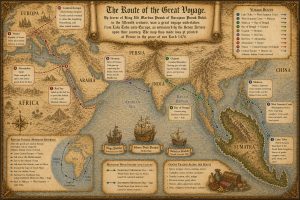
A fictional manuscript lies at the heart of the Pavilion: Mentjap jang Tiada Bertjap: Plajeran Agoeng — Printing the Unprinted: The Grand Voyage. It is attributed to Datu Na Tolu Hamonangan, an imagined archivist, artist, astronomer, and legal theorist of the Harajaon Pusuk Buhit. This 15th-century Sumatran kingdom was known for maritime technology, astronomy, trade networks, governance, and artistry. The manuscript visualizes a remarkable 14-year voyage from 1472 to 1486. The journey begins at Lake Toba. It follows the West Sumatran coast, through Malacca, across the Bay of Bengal, passing through Gujarat, Hormuz, the Red Sea, and Alexandria. It ends in Venice and Central Europe. Three ships carry this expedition. Siboru Deak Parujar, named for the Batak Goddess of Creation, is the mothership. Naga Padoha, the Cosmic Serpent, is the escort vessel. Sahala ni Ombak, the Wave Spirit, is devoted to scientific discovery. Together, these ships symbolize inquiry, not conquest. They reach outward to observe, record, and understand. They never claim territory. Datu Na Tolu Hamonangan documents the voyage in a leather- or wood-bound manuscript. It is composed in the tradition of the Batak pustaha, a sacred knowledge book compiled by specialist scribes. Its pages contain etchings, drawings, sketches, and vivid observations. Seven artists were selected through a lengthy process based on their work and contributions to the conceptual treasury of contemporary Indonesian art. They responded to this fiction through printmaking techniques.
The pustaha itself is a form that demands attention before the manuscript’s content can be properly understood. Among the Batak people of North Sumatra, the pustaha was the primary instrument of knowledge transmission: written by the datu — the ritual specialist who served simultaneously as healer, astronomer, legal authority, and custodian of sacred texts — in a specialised language not intended to be read by the uninitiated, accumulating rather than concluding, oriented toward the transmission of knowledge across generations rather than the declaration of a fixed and finished truth.
The datu was, in the most rigorous sense, a scholar: one whose epistemological framework encompassed astronomy, medicine, divination, law, and the interpretation of natural phenomena, but whose scholarship operated through categories that European institutional frameworks did not recognize as scholarship and therefore did not preserve. The Batak tradition even preserves the memory of a pustaha so comprehensive that it was said to contain all the knowledge possessed by humankind — a text known as Tumbaga Holing, which many Batak believe the Dutch took to the Netherlands, where it remains, if it exists, beyond reach. Whether this account is historical or mythological is, in a meaningful sense, irrelevant.
What it preserves is something more important than a verifiable fact: the experience of a civilization that has lived with the knowledge that its most significant intellectual inheritance was removed, recategorized, and made inaccessible. This is not a grievance. It is an epistemological condition — one that shapes, with ongoing consequence, the relationship between Indonesian cultural production and the international institutions that claim to represent it. It is also the condition that makes documentation an insufficient response. When the archive itself was the instrument of removal, returning to the archive for legitimacy reproduces the problem rather than addressing it. Fiction, in this context, is not a retreat from evidence. It is the most precise available response to a situation in which the evidence was never permitted to exist.
The pustaha’s logic — accumulative, transmission-oriented, epistemologically plural — is precisely what makes fiction the right instrument for this project. Whether the Hamonangan manuscript exists in the strict archival sense is, ultimately, beside the point — and understanding why it is beside the point is the key to understanding what this Pavilion is actually doing. The question of the manuscript’s verifiability is not suppressed or evaded; it is held deliberately open, because it is precisely in that openness that the curatorial argument operates. The manuscript functions as what might be called a counter-archive: not a replacement for the dominant historical record, but a structural challenge to the conditions under which that record was assembled and the authority it continues to claim. Its ambiguity is not a limitation of the curatorial framework. It is the framework’s most precise instrument.
To grasp the full significance of this, it is necessary to understand what an archive actually is — and what it is not. An archive does not simply preserve the past. It produces it. The documents that enter an archive, the language in which they are cataloged, the categories under which they are organized, the institutions that control access to them: all of these are decisions, made under specific historical conditions, by specific agents with specific interests. The dominant archive of global maritime history was assembled under conditions of European colonial expansion, in which the primary purpose of documentation was to establish territorial and commercial claims, and in which the knowledge systems of non-European civilizations were either ignored, appropriated without attribution, or actively suppressed. What the archive tells us about who crossed which oceans, when, and to what end, is therefore not a neutral account of what happened. It is a record of what those who controlled the archive chose to record — and a silence, vast and structured, where everything else once was.
The manuscript of Datu Na Tolu Hamonangan occupies that silence. It does not claim to fill it with a competing certainty. It claims, more modestly and more radically, that the silence is not empty — that it is full of voyages, observations, encounters, and forms of knowledge that the dominant archive declined to admit. The 15th-century maritime expedition it describes, sailing from Lake Toba through the Bay of Bengal, Gujarat, Hormuz, the Red Sea, Alexandria, and onward to Venice, is presented not as a discovery — the word carries too much of the logic it seeks to displace — but as an encounter: a meeting between a Sumatran civilisation of considerable intellectual and technical sophistication and a European city that did not yet know it existed. Venice, in this telling, is not the center of the world. It is one port among many, reached after years of navigation by people who already knew, from their own traditions of astronomy and maritime science, how to find it.
This reframing of Venice is not incidental to the Pavilion’s argument. It is the argument’s heart, both geographical and metaphorical. The city that hosts the world’s oldest and most prestigious international art exhibition — a city that has, for more than a century, functioned as the site at which nations present themselves to the world and at which the world’s judgement of cultural value is, in some sense, rendered — is reimagined, through the manuscript’s fiction, as a place that was once arrived at by strangers who brought with them knowledge it did not have. The implications for the Biennale itself are direct and deliberate. If Venice has always been a destination, the manuscript asks: destination for whom, on whose terms, and at what cost to those whose arrival was not recorded? And if the Biennale continues to function as a site at which cultural value is determined, who determines the criteria, and what forms of knowledge remain, still, unprinted?
These are not rhetorical questions. They are the questions that the present moment makes urgent and impossible to defer — and they are the questions that this Pavilion takes as its starting point.
Indonesian Contemporary Art:
Cultural Inheritance, Structural Constraint
The emergence of Printing the Unprinted is inseparable from the broader trajectory of Indonesian contemporary art. This trajectory cannot be understood without accounting for the specific historical, political, and institutional pressures that have shaped artistic practice across the archipelago over the past century. Indonesia is not simply a nation with a rich cultural heritage; it is a nation whose relationship to that heritage has been systematically mediated, interrupted, and contested — by colonialism, by authoritarian governance, by the commercial forces that followed political liberalisation, and by the asymmetric structures of international art circulation that continue to determine which practices are made legible and which remain, in the most literal sense, unprinted.
The archipelago encompasses hundreds of distinct ethnic groups and cultural traditions, each with its own expressive forms, epistemologies, and historical memory. This plurality has never resolved itself into a singular national aesthetic, nor should it. What Indonesian art history reveals, when examined on its own terms rather than through the frameworks imposed by external institutional narratives, is a sustained and often contentious negotiation between artistic autonomy and social responsibility — between the individual maker and the collective from which that maker draws meaning. This negotiation is not peripheral to the work; it is constitutive of it. The concept of gotong royong — cooperation, communal labor — is not merely a cultural value borrowed by artists as a metaphor. It is a structural principle that has organized Indonesian artistic practice from its earliest modern formations through to the collective and research-based practices that have come to define its most significant contemporary contributions.
The political ruptures of the 20th century left deep marks on this trajectory. Under the authoritarian conditions of the New Order period, artists developed practices of oblique critique, working through allegory, material experimentation, and collective organization precisely because direct political expression carried severe consequences. The emergence of the Indonesian New Art Movement (Gerakan Seni Rupa Baru) in the mid-1970s — which rejected the decorative, the individualist, and the politically disengaged — was not simply an aesthetic revolt. It was an assertion that art practice must account for its social conditions, that the question of what art is cannot be separated from the question of what it is for and whom it serves. This position, articulated under repression, became the generative foundation for the more expansive collective practices that followed the political reforms of 1998 — practices that have since drawn sustained international attention precisely because they propose a model of artistic production that is communal, research-driven, and structurally resistant to the logic of the individual commodity object.
Yet visibility within international art circuits has brought its own complications. The very qualities that make Indonesian collective and process-based practice intellectually significant — its embeddedness in specific social and historical contexts, its resistance to easy translation into portable, market-legible objects — have also made it vulnerable to a particular form of institutional appropriation, in which the form of collectivity is celebrated. In contrast, its specific content and conditions are abstracted away. The history of Indonesian art’s encounter with international exhibition infrastructure is, in part, a history of this tension: between the desire for recognition and the awareness that the terms of recognition are not neutral. Practices rooted in collectivity, critical historiography, and material research have consistently redefined how Indonesian art positions itself internationally — not as a regional variant of a universal contemporary, but as a producer of knowledge on its own terms.
It is precisely this tension — between the desire for international recognition and the awareness that recognition is offered on terms that were not designed with Indonesian practice in mind — that Printing the Unprinted addresses directly. The project does not arrive at the Venice Biennale as a declaration of arrival, as though international recognition were the horizon toward which Indonesian art has been striving. It arrives as a proposition about method: about how artistic practice can be organized, what it can produce, and what it can refuse. Within the space of a major international exhibition, where the pressure to produce legible, translatable cultural statements is considerable, the Pavilion insists on a different order of engagement — one grounded in the situated, the processual, and the irreducibly particular.
This insistence is not incidental. It reflects a structural argument about what the Venice Biennale, as an institution, currently demands of its participants and what it might instead be asked to accommodate. The dominant model of national pavilion participation — in which works are produced in the artist’s home country, shipped to Venice, installed in a white cube or its equivalent, and presented to an international audience as a finished statement of national cultural identity — is a model that implicitly reproduces the logic of the trade fair, even when its intentions are otherwise. It separates the act of making from the act of showing, and in doing so, removes from the exhibition precisely what is most alive in artistic practice: the negotiation, the uncertainty, the material encounter with conditions that the artist did not fully anticipate. What is displayed under this model is the outcome of a process the audience is not permitted to witness. What is withheld is the process itself — and with it, the most significant evidence of what art, as a form of inquiry, is actually capable of.
By invoking the Batak Kingdom and the port networks of Barus, the project does not seek to reconstruct a definitive past, but to reactivate a field of historical possibility — one in which Southeast Asia is not a passive recipient of global modernity but an active participant in its formation. The fictional manuscript of Datu Na Tolu Hamonangan functions here not as a historical claim but as an epistemological provocation: a speculative archive that asks what the historical record would look like if compiled by different hands, from different vantage points, with different assumptions about what constitutes significant knowledge. Venice, in this fiction, is not the center of civilization that the European archive has long presented it as. It is one port among many — a city that the Sumatran navigators reach after crossing the Bay of Bengal, Gujarat, Hormuz, the Red Sea, and Alexandria. To arrive in Venice, in the world of the manuscript, is not to arrive at the apex of a hierarchy. It is to arrive, after a journey of fourteen years, at a place that does not yet know you — and to begin, patiently and precisely, the work of making yourself known through what you observe, record, and make. This is the metaphor that the Pavilion brings to Venice in 2026.
The Mediterranean — the same sea that the manuscript’s voyagers crossed as astronomers, diplomats, and artists — is today one of the world’s most dangerous passages for those whose movement is not sanctioned by the international order. The sea that, in the manuscript, connects civilizations has become, in the present, a passage without guarantee. The question of who arrives where, and on what terms, and what they are permitted to bring with them, is not abstract. It is the condition under which this exhibition takes place.
To situate an Indonesian artistic project within Venice through the figure of a pre-modern maritime voyage that imagined the city as a place of open encounter is, in this light, an act of sustained political imagination. It does not aestheticize the crisis; it uses the resources of fiction and historical speculation to illuminate the structural conditions that produce it. It asks, with precision and without sentimentality, what it would mean for cultures to approach one another not as competitors for institutional recognition, not as representatives of national brands, but as navigators — carrying knowledge that has not yet been translated, arriving in a place that has not yet learned to read them, and beginning, in the act of making together, the slow and difficult work of mutual legibility.
This is also, crucially, an argument about the future of contemporary art practice. The trajectory that Printing the Unprinted extends and consolidates — process-based, collectively organized, intergenerational, grounded in specific historical and material conditions, resistant to the separation of production from encounter — is not a marginal tendency within contemporary art. It is, increasingly, the tendency that serious critical discourse has identified as most adequate to the conditions of the present. The argument, developed across decades of curatorial and scholarly writing, is that knowledge production in the arts is not a stable or predetermined category. It is constituted through acts of research — through the encounter between a practice and the specific conditions in which it operates, between an artist and the material and social world that the work must negotiate. This understanding of artistic practice as a form of situated knowledge production, rather than as the manufacture of aesthetic objects for circulation, has profound implications for how international exhibitions are organized, what they are asked to demonstrate, and what they leave room for.
The Indonesian Pavilion’s model is a concrete, replicable idea for international exhibitions: residency as an approach, process as an argument, and living laboratory as a curatorial form. Instead of merely showcasing pre-existing cultural production, a national pavilion can be a site of inquiry, where artists work in conditions they did not design, with colleagues from diverse backgrounds, in a city whose history and contradictions influence their work. This knowledge is not transferable or readily produced elsewhere; it arises from the encounter itself, and its uniqueness is the source of its critical and artistic force.
What this Pavilion proposes is a reorientation of the relationship between artistic practice, institutional structure, and the conditions under which both operate. The marks made in Venice in 2026 will not resolve the crises that surround them. But they will constitute evidence — durable, material, publicly legible — that encounter is still possible, that knowledge can still be produced through proximity and shared making, and that the record is not yet closed. The question that follows is how that reorientation is achieved — and the answer lies not in a different selection of objects, but in a different relationship to the act of making itself. That relationship is the one this project calls fiction.
Fiction as Counter-Archive
At the core of the Indonesian Pavilion lies a deliberate insistence on fiction — not as fabrication, evasion, or aesthetic ornament, but as a rigorous epistemological approach. This distinction is foundational and must be held with precision. Employing fiction as a curatorial framework does not entail a rejection of truth. Rather, it underscores that truth, defined as content recorded, preserved, and accepted as fact, is constructed by those in positions of authority. Official histories lack objectivity, as they emerge from institutional processes, specialized languages, and exclusionary criteria. Such histories frequently exclude knowledge that does not align with established norms. Within this framework, fiction serves not as an evasion of scholarly rigor but as a method to confront the limitations inherent in the official record.
The archive, as a concept and as an institution, does not simply preserve the past. It produces it. What enters the archive, and what does not, is never a neutral process of selection: it reflects the priorities, the anxieties, and the power relations of those who control the conditions of preservation. Dominant narratives of global exploration — including those that have organized the history of maritime civilization, intercultural encounter, and what counts as significant human achievement — have been constructed from archives that were themselves built under conditions of colonial administration, missionary intervention, and the systematic dispossession of non-European knowledge systems. These archives record what those in power chose to record, in the languages they controlled, through the categories they imposed. They are not windows onto the past. They are arguments about it — and it is into this argument that fiction intervenes.
Fiction intervenes at precisely this point of structural exclusion — not to replace the archive with invention, but to expose the archive’s own fictionality. When a curatorial framework introduces a manuscript that is at once credible and unverifiable, it provokes epistemological reflection: it asks the viewer to examine the conditions under which they grant or withhold belief, and to recognize that those conditions are not self-evident but historically produced. This is not a postmodern gesture of relativism. It is a methodologically serious proposition about the limits of institutional knowledge and the forms of intelligence systematically excluded from the record.
The use of fiction as a curatorial framework matters beyond this Pavilion alone. It raises a broader question: what should curators do when the available historical record is not just incomplete, but shaped by the biases of those who built it? In contrast to the traditional view of exhibitions as mere displays, there has been a growing recognition in recent decades that they are also forms of research. A well-conceived exhibition does not just show what is already known; it brings together materials, histories, and perspectives that have been kept apart, producing new ways of thinking. Curating, in this sense, is itself a form of knowledge-making. Fiction fits naturally within this understanding because, unlike approaches limited to documented evidence, it allows curators to work with what the archive has left out and to ask questions that records alone cannot answer.
Fiction is powerful as a curatorial tool because it embraces what cannot be proven, rather than relying solely on evidence. This might seem like a weakness, but in fact, it is a strength. When the historical record has gaps—when evidence was never collected, when voices were never transcribed, or when entire ways of knowing were excluded from the archive—the honest response is not to claim certainty where there is none, but to hold the question open. Here, imagination does not oppose rigor; it partners with it. Speculation is not the opposite of careful thinking, but, where the archive is silent, often its most careful form. It distinguishes between what is known and unknown: we do not know for certain, but here is what the evidence suggests, what the silence might contain, and why it matters that we ask.
By presenting the manuscript of Hamonangan as both credible and unverifiable, Printing the Unprinted destabilizes the hierarchy between fact and imagination in a manner that is precise, deliberate, and theoretically consequential. It does not claim that the voyage happened. It does not claim that it did not. It holds both possibilities simultaneously open, and in doing so, it forces a confrontation with the question that the established archive cannot answer: not whether this specific voyage took place, but whether the conditions under which we determine what took place are trustworthy. The manuscript’s fictional status is not a weakness in the curatorial argument; it is the argument’s
sharpest instrument.
What Printing the Unprinted proposes, in this light, is a model of curatorial practice adequate to a world in which the archive has been revealed, with unusual clarity, as a site of contestation rather than of settled truth. The Hamonangan manuscript does not offer an alternative truth to replace the dominant one. It offers an alternative relationship to truth itself — one grounded not in the assertion of certainty but in the sustained, disciplined practice of inquiry. This is the epistemological position that the Pavilion inhabits, and it is the position that gives the use of fiction its scholarly and ethical force. Fiction, here, is not the opposite of knowledge. It is one of its most honest forms. A fictional fragment from the manuscript states:
“They will ask for proof, as if the sea keeps receipts. But the tide records differently—it erases to remember, and remembers by erasing.”
Here, fiction functions as a critical tool — one that exposes how belief in history is constructed, and how absence within the archive does not equate to absence in lived experience. The implications of this position extend beyond the specific historical argument the manuscript advances. They reach into the question of what curatorial practice can become when it takes seriously the knowledge that the archive has declined to hold — and what it must become if it is to remain adequate to that task.
Employing fiction as a curatorial framework is significant not only for its impact within this Pavilion, but also as a potential model for future exhibitions. Most major exhibitions continue to operate within a conventional logic: they display verified objects, present authenticated histories, and construct narratives controlled by the institution. While this approach has certain strengths, it is fundamentally limited because it can include only what already conforms to established categories. Objects from non-Western cultures may be incorporated, but only after being translated into Western museum classifications. Historical injustices may be addressed, but only according to institutional terms. Although exhibitions may expand geographically, the criteria for what constitutes significant knowledge remain unchanged. Fiction disrupts this paradigm. By refusing to treat verified facts as the sole legitimate foundation, a curatorial framework based on fiction creates space for knowledge systems and modes of understanding that institutions have historically excluded. These are presented not as curiosities, but as serious propositions warranting engagement.
This approach holds particular historical significance for Indonesian contemporary art. Indonesian artistic practice has rarely conformed to the standard model of the individual artist producing objects for institutional display. From the communal knowledge-making of the pustaha tradition to the politically engaged collective practices of the New Art Movement in the 1970s, a consistent pattern is evident. The research-based and community-driven work that has defined Indonesia’s most significant recent international contributions demonstrates that knowledge is collectively produced, transmitted through practice, and inseparable from its conditions of production. These are not merely aesthetic choices; they reflect a profound cultural understanding of knowledge and its operation. Printing the Unprinted does not import these values from elsewhere but draws them directly from the cultural history it engages with. In this sense, the fictional curatorial framework and Indonesian artistic tradition are inherently aligned.
This perspective is highly significant for the future of contemporary art practice. The focus is not on novelty, but on recovery. The tools necessary for a more honest and adequate curatorial practice are not awaiting invention; they already exist within knowledge traditions that art institutions have marginalized for decades. Contemporary society requires ways of thinking that accommodate complexity without reducing it to simplistic answers. It demands frameworks that enable genuine encounters across differences and approaches to truth that do not rely on a single authorized narrative. These concepts are not new; they are actively practiced and sustained within traditions that the dominant archive has historically overlooked.
Space, Process, and the Living Laboratory
The arguments made so far — about fiction, counter-archive, and the ethics of making — do not exist in the abstract. They are grounded in a specific site, medium, and method of working. Venice, process, and printmaking are deliberately linked in this Pavilion to argue that the city is not a neutral site or a restored cultural center. It is one arrival point among many — echoing the trade and migration routes of the Hamonangan manuscript — where arrival means entering new, unknown ground rather than claiming cultural authority.
That framing carries a different weight when set against the present. The manuscript imagines Venice as one port among many — reached after long crossings, not a destination that confers status. Venice today remains a city where people arrive under very different conditions: some as guests of an international art institution, others crossing the same sea with no guarantee of welcome. The manuscript does not resolve this tension. It holds it open — and in doing so, it makes the Pavilion’s choice of site into something more than a logistical decision.
The choice of printmaking deepens this, and makes the residency at the Scuola Internazionale di Grafica not a logistical convenience but a conceptual necessity. Printmaking’s material logic parallels the historical processes the exhibition examines: etching requires time, repetition, and responsiveness to the environment — lines form through corrosion, surfaces record pressure and contact. History accumulates the same way, gradually and under circumstances. Venice’s humidity, tidal rhythms, and worn surfaces leave traces in the prints that cannot be produced elsewhere. The works made at the Scuola are evidence of this specific interaction — shaped by this city, this climate, this duration. They could not have been determined in advance, which is precisely the point: the two-month residency is not a production window. It is the condition under which the work becomes possible.
In the meantime, fiction and process are interwoven here: residency works explore rather than just illustrate the manuscript’s narrative. They serve as meeting points: between artists of different generations, between Indonesian practices and Venetian conditions, and between individual gestures and collective dialogue. These encounters, recorded through the works, remain open—never finalized as fixed objects. Making this becomes an ongoing inquiry. Similarly, the Hamonangan manuscript is not fixed; it invites interpretation, contradiction, and reinvention. Each artist responds differently, resulting in a constellation of responses rather than a single narrative.
This mirrors the logic of printmaking: an etched plate produces many impressions, each differing in ink, pressure, and texture. Likewise, the manuscript generates multiple histories, none claiming full authority; instead, each contributes to a broader field of meaning, which remains open.
Setting this fiction in Venice heightens tension by contrasting imaginative storytelling with the city’s documentation, contracts, and mercantile precision. The residency critiques this legacy rather than rejects it. Creating speculative work in a city of archival authority reveals how even factual documents reflect perspective and demonstrates that archives are never neutral. A fictional passage from the manuscript captures this argument:
“In the city where everything is written, we learned to write what could not be written. Not to deceive, but to show that the page was never complete.”
Fiction here is a tool for exposing the limitations of history — but it is also a spatial practice. The manuscript and the residency both resist official closure, and Venice is the site where that resistance takes material form. Artists rework their history through their collaborative practice, treating the city not as a backdrop but as an active participant in the making of meaning. The exhibition argues that history is actively shaped, not just recorded — and that Indonesia is presented here not through a fixed narrative, but as a proposal for understanding how histories are collectively made.
Process, Collaboration, and the Ethics of Making
The argument for fiction and the argument for residency converge on a single question: what does it mean to make something, and what conditions does that making require? The preceding sections have established why the archive is insufficient and why the encounter matters. What remains is the question of how that encounter is structured — and that is the question this section addresses.
These process concerns are concrete. They arise from the material logic of printmaking, the exhibition’s primary medium. Etching—cutting, chemical change, inking, transfer—serves as both method and metaphor. Like etching, history is constructed gradually, shaped by resistance and yield. Each mark results from the interplay of material and intention, pressure and chance. Meaning in printmaking
and history builds layer by layer, not from a single statement. This process-based approach to meaning is the epistemological model the exhibition proposes.
Prioritizing process is a deliberate resistance to the demand for oversimplified meaning — a demand that is especially distorting when the subject is fragmented, contested, or structurally excluded from the dominant record. Beyond legibility, process introduces time: revision, hesitation, contradiction. This engagement with time is crucial for working through fragmented and unresolved histories because it allows questions to remain open. In contrast, a finished object forecloses the questions it generates, while process keeps them visible. Collaboration takes this further: if the process redefines when a work is finished, collaboration redefines who counts as an author.
The solo artist model centers meaning on one perspective; shared authorship distributes it, creating multiple viewpoints that resist a single narrative. This redistribution of authorship is not a stylistic preference. It reflects a structural principle embedded in Indonesian cultural practice — the gotong royong tradition of communal labor and shared responsibility, which has organized artistic production in Indonesia from its earliest modern formations to the collective and research-based practices that define its most significant contemporary contributions. Indonesia’s history is diverse, internally contested, and unevenly preserved. No single perspective can hold it. Collaboration does not merely supplement individual practice; it is the condition under which a more adequate account becomes possible.
At the Scuola Internazionale di Grafica, seven artists collaborate, share methods, and challenge each other’s views. The residency generates a continuously evolving dialogue, not finished arguments. This open, collaborative approach is necessary to address the manuscript’s instability. Process and collaboration together leave meaning unresolved, provoking further interpretation.
A fictional fragment from the manuscript encapsulates this epistemic condition:
“No one among us could read the whole sea. So we read it together
—each taking a fragment, each correcting the other, until the voyage
became possible.”
The passage makes the epistemological claim that the project rests on:
that knowledge of the scale and complexity this voyage requires — navigating unfamiliar seas, reading foreign skies, negotiating unknown cultures — cannot be held by a single mind or produced through a single method. It must be distributed, corrected, and accumulated. This is not a statement about collaboration as a value. It is a statement about what knowledge, under conditions of genuine complexity, actually demands.
Space as Curatorial Strategy
Process and collaboration, as the preceding section has argued, change what it means to make a work and who counts as its author. But they do not fully account for where the work is made — and in this project, location is not incidental. The argument of this section is specific: that Venice is not a neutral backdrop for the exhibition but an active epistemological condition, one that shapes what can be made, what can be encountered, and what can be known through the act of making here rather than elsewhere.
The Indonesian Pavilion treats the site not as a backdrop but as an active condition of production. Venice shapes what is made here — not through atmosphere or symbolism, but through the specific material and social pressures of working in this place, with these collaborators, under these constraints. What is made in Venice bears the evidence of Venice. The structure of the encounter determines what can be known through it.
These conditions are not just background: the city’s humidity, tides, and worn surfaces directly shape both the process of making the works and the viewer’s response. The exhibition does not present a final interpretation; rather, it serves as a space where artistic form, audience encounter, and interpretation unfold together. Printing the Unprinted grounds this exchange in Venice’s context—a city defined by the sea, commerce, and the constant arrival of outsiders, who are sometimes not welcomed.
The Scuola Internazionale di Grafica embeds artists within Venice, making their response unique to its context. Unlike the standard pavilion model, this approach embraces genuine encounters with place and process, shaping work through collaboration and ongoing research. Exhibition design supports this openness, inviting viewers to construct meaning actively rather than passively receive a national statement.
Biennials can be sites of genuine critical inquiry. That capacity is consistently undermined when pavilions default to cultural showcase — polished objects shipped from elsewhere that confirm existing hierarchies rather than test them. The Indonesian Pavilion’s model is a direct response to that tendency: not a critique from the outside, but a structural refusal enacted from within.
Artists who spend two months working in Venice — negotiating its histories, its light, its material conditions — produce work that bears the evidence of that negotiation. That evidence cannot be faked or shipped in advance. It is the residency itself, not what the residency produces, that constitutes the argument.
The Indonesian Pavilion refuses to accept those terms. It proposes instead a curatorial model grounded in process, co-presence, intergenerational exchange, and the situated knowledge produced through sustained engagement with a specific place and a specific community of practice. In doing so, it does not argue for a seat at an existing table. It proposes reconsidering what the table is for.
That proposition is embodied in the manuscript itself. The voyage of Datu Na Tolu Hamonangan did not end in Venice. It continued — into Central Europe, into the unknown. The manuscript does not conclude; it accumulates. The Pavilion works the same way. It does not deliver a finished statement. It opens a process and leaves the question of what the unprinted might become genuinely open.
The Seven Artists
The selection of seven artists to represent Indonesia at the 61st Venice Biennale is not incidental to the curatorial argument. It is, in the most precise sense, constitutive of it. Each artist brings a distinct generational formation, a distinct material sensibility, and a distinct relationship to the cultural and political histories that Printing the Unprinted sets out to address. Together, they do not form a unified front. They form a field of productive tension — one that mirrors, at the level of artistic practice, the plurality that the exhibition argues for at the level of history.
Agus Suwage (b. 1959) using painting, drawing, printmaking, and mixed media, Agus Suwage’s practice questions identity under regimes of power and representation, using his own face as both object and subject. His self-portraits are not narcissistic but sites where personal vulnerability meets political critique, destabilizing the authority of images. Shaped by resistance to authoritarianism, his work places the Indonesian experience within global debates on subjectivity, surveillance, and power. He belongs to a generation that came of age under the New Order — a period in which the relationship between artistic expression and political power was one of constant, dangerous negotiation. His practice, marked by a sustained engagement with the body as a site of cultural inscription and political vulnerability, brings to the Pavilion a depth of historical experience that cannot be abstracted or theorized away. His presence anchors the project in the lived conditions of Indonesian art’s most contested decades, and his continued vitality as a practitioner demonstrates that the critical impulse of that period was not exhausted by the political changes of 1998 — it was transformed and deepened.
Syarizal Pahlevi (b. 1965) works in woodcut and direct printing, drawing on everyday objects and vernacular culture to expose how power and ideology operate through ordinary visual forms. His practice positions popular culture as a field of contestation, continuing Indonesia’s tradition of socially engaged printmaking. His works are at the intersection of cultural memory, material experimentation, and the politics of representation. His formation in the period immediately preceding the Reformasi gives his practice a particular sensitivity to how cultural identity is constructed, contested, and instrumentalized — by the state and the international art market alike. His engagement with the fictional manuscript operates not as illustration but as critical dialogue: he brings to the Hamonangan narrative the skepticism of someone who has watched official stories be made and unmade, and whose artistic response has always been to find the places where the official story does not hold.
Nurdian Ichsan (b. 1971) Nurdian uses clay as a contemporary medium to question identity, spirituality, and collective memory. Transforming ceramics into a critical language, his work carries historical trauma and spiritual resonance, reacting to material tradition to address present conditions. His practice engages with the material and conceptual residues of that transition: the objects, images, and spatial conditions that bear the traces of a society in the process of remaking itself. In the context of the Pavilion, his work brings a particular attention to what survives — what marks, what impressions, what traces persist in material form even when the structures that produced them have been dismantled.
R.E. Hartanto (b. 1973) utilizes realist portraiture to investigate the intersection of human psychology, biological impulse, and social structures. His practice explores existential inquiries, examining how the weight of the past dictates the pursuit of meaning within a fractured, modern ecosystem. His practice is alert to the politics of legibility — to the question of what gets read, by whom, and under what conditions. In a project structured around a manuscript that is at once credible and unverifiable, his contribution carries a specific critical weight: he brings to the Pavilion a sustained interrogation of the conditions under which meaning is authorized and withheld.
Theresia Agustina Sitompul (b. 1981) uses and expands printmaking to question gender roles, colonial inheritance, and the invisibility of women’s labor. Through everyday objects and household tools, print becomes both method and metaphor—an act of care and resistance. She brings to the project a practice rooted in the relationship between personal and collective memory, between the intimate and the historical. Her Batak heritage gives her a particular and non-generic relationship to the pustaha tradition and to the fictional world of the Hamonangan manuscript — not as an external reference but as a living cultural inheritance. Her presence in the Pavilion is a reminder that the cultural history this project draws upon is not an abstraction. It is embodied, transmitted, and still being negotiated by people for whom it is not history but identity.
Mariam Sofrina (b. 1983) is known for her photorealistic landscapes and cityscapes, using light and detail to evoke nostalgia, uncertainty, and unstable logic, challenging the accuracy of photography and reality. Her works sustained interest in the relationship between the visible and the invisible — the marks that are made and those that are withheld, the images that circulate and those that do not. This is her first time for printmaking. Her practice brings to the Pavilion a formal precision that operates as a counterpoint to the project’s more expansive historical and political arguments: she asks, at the level of the single mark, what it means to print something, what it means to leave a trace, and what it means to choose what is left out.
Rusyan Yasin (b. 1994) is the youngest of the seven, and his presence in this intergenerational assembly is not merely symbolic. He uses drawing and travel sketching to document space, memory, and displacement. His fragmentary, process-driven work draws from mobility and lived experience. He represents a generation that has grown up with the full weight of Indonesia’s post-Reformasi contradictions — the expanded freedoms and the new forms of constraint, the international visibility and the continuing structural inequities — as simply the given conditions of practice. His formation is also the most globally connected of the seven, shaped by the digital circulation of images and ideas that have transformed the conditions of artistic practice worldwide. His contribution to the Pavilion brings a different temporal relationship to the questions the project raises: for him, the unprinted is not only a historical condition but a present one, experienced in the daily negotiation between what can be said and what cannot, what can be shown and what remains, still, outside the frame.
Together, these seven artists span more than three decades of Indonesian artistic formation — from the authoritarian pressures of the New Order through the political rupture of 1998 to the complex, globally connected present. They do not share a single aesthetic position, and the Pavilion does not ask them to. What they share is a commitment to practice as a form of inquiry, to making as a mode of thinking, and to the proposition that the encounter between different formations and sensibilities — held together not by institutional directive but by a shared question — is itself a form of knowledge production. This is precisely the model that the Pavilion proposes as an alternative to the conventional national showcase: not a unified cultural statement, but a living conversation, conducted in public, in a foreign city, through the irreducibly material practice of printmaking. It is this model — and the specific artists who enact it — that the closing argument must now account for.
The Unprinted as a Condition of the Present
Printing the Unprinted ultimately proposes a shift in how global histories are understood. The exhibition contends that the present can only be read through multiple, uncertain, and speculative narratives — not through a single authoritative version. This is not only an aesthetic position. It is an argument about what knowledge is, who produces it, and under what conditions it is permitted to count.
The political conditions that make this argument necessary have been established in the opening sections of this essay. What the closing argument addresses is not the conditions themselves but what follows from them: the responsibility of an exhibition, made under these conditions, to account for its own terms of production.
This reorientation of who tells the story is both a historiographical and curatorial claim. The Grand Voyage shifts from a narrative of discovery to one of reorientation—a reversal of the traditional exploration model, which divided the world into those who discover and those who are discovered, those who name and those who are named. The Hamonangan manuscript challenges this division, envisioning knowledge as multidirectional. Cultural encounters are thus opportunities for mutual transformation, not acts of conquest. The main historiographical argument of Printing the Unprinted is that the past contains more than has been revealed; thus, imagining lost histories is a historical and artistic duty.
The argument about knowledge moving in multiple directions directly shapes how exhibitions are made. The central issue is not just which artists are included, but under what conditions. When a pavilion displays pre-produced work — created in the artist’s usual environment and formatted for an international audience — it accepts the existing terms of participation without examination. It grants visibility while withholding the conditions under which visibility might mean something. What this model omits is the actual substance of artistic practice: hesitation, revision, dialogue across difference, and the slow negotiation between an artist’s formation and the conditions they did not anticipate.
The residency model enables not just a different kind of exhibition, but a different kind of knowledge — one produced through fiction, printmaking, and practices rooted in a specific place and time. It does not claim to recover what was lost. It claims something more precise: that the tools for a more adequate account already exist, in the pustaha tradition, in gotong royong, in the intergenerational friction between artists whose formations differ. What has been missing is not the knowledge. It is the institutional willingness to take that knowledge seriously on its own terms.
The residency model — two months of collaborative production in a foreign city, across generations and disciplines — does not sidestep the political conditions of the present. It responds to them through form. It requires artists to work in conditions they did not design, with people they did not choose, in a place whose pressures they could not have anticipated. The work that results is not documentation of that experience. It is evidence of it — specific, material, and unrepeatable.
That evidence does not point to a conclusion, but to a commitment. The title itself — Printing the Unprinted — is ultimately an act of faith in this possibility. To print what has not been printed is to insist, against the archive’s weight and the institution’s inertia, that the record is not yet closed. The voyage is not over. The page remains open.
That faith, however, is not unconditional; it depends on the exhibition’s institutional context. The Biennale’s pavilion structure has changed little over the past century: nations present work, critics and collectors attend, and reputations are made or consolidated. This arrangement is not neutral. It rewards legibility—the finished object, the coherent national statement, the work that travels well and reads quickly—and does not reward process, friction, or knowledge that takes time to become visible. Thus, for any pavilion, the key question is not just what it shows, but whether it accepts or challenges the conditions under which it is seen.
Printing the Unprinted rejects predetermined outcomes—not just rhetorically, but structurally. By choosing residency-based work rather than shipping pre-made pieces, the exhibition ensures the works cannot be predetermined. The argument emerges from the encounter: seven artists, a Venetian printmaking institution, and two months of collaboration. The works produced are not illustrations of a thesis, but evidence that an event occurred—one that required this specific place, time, and group of people.
Fiction operates in the same way. The manuscript of Datu Na Tolu Hamonangan does not fill a gap in the archive. It asks why the gap is there. Why does the historical record contain no account of Sumatran navigators in 15th-century Venice? Why is there no trace of the knowledge systems they carried, no acknowledgment of the civilizations already in complex motion before European expansion? The answer is not that such exchanges did not happen. The answer is that the archive was not designed to hold them—and that this design was not accidental.
That friction is not just structural — it is generational. The seven artists in this exhibition were not chosen to represent a spectrum of Indonesian identities, but because their distinct generational backgrounds create a particular kind of productive friction. The New Order’s cultural controls shaped Agus Suwage’s practice, while Rusyan Yasin’s work emerged afterward — amid a digital landscape, post-authoritarian openness, and a different relationship to tradition. Between these two poles, and among the five artists in between, there is no shared aesthetic and no single position. What unites them is a willingness to work in proximity, to let the encounter matter, and to see what a pustaha made collectively in Venice might actually hold. Because this generational friction is productive rather than decorative, the question of institutional support becomes urgent. The Biennale could treat this work seriously — not as diversity programming, but as a genuine epistemological proposition. It has the infrastructure, convening power, and institutional weight to make residency-based, process-oriented, intergenerational projects a viable model rather than an exception. Whether it does so depends on what it understands its own function to be.
Before that question can be fully answered, however, the project must reckon with the risks it carries. These commitments do not exempt Printing the Unprinted from a harder set of questions about what it means to use fiction as a curatorial framework — questions that the exhibition must be willing to hold rather than deflect. The first concerns the collapse of the register. When fiction and curatorial argument occupy the same space, without clear demarcation, the distinction between speculation and claim becomes unstable. A viewer encountering the Hamonangan manuscript may reasonably ask: Is this a historical proposition or an artistic one? If the answer is both, the project risks being read as historical revisionism — as an assertion that this voyage happened, rather than an inquiry into why no such voyage was recorded. The danger is not that the fiction will be believed, but that its ambiguity will be used to discredit the genuine epistemological argument at its core. Fiction deployed curatorially requires a discipline that is easy to lose: the discipline of keeping the question open without allowing it to slide into a claim.
The second risk cuts deeper. Fiction, when used to give form to historical absence, can aestheticize the very violence it means to expose. To narrate the silenced voyage beautifully — to give it ships with names, a manuscript with texture, a datu with intellectual authority — is to produce an object of cultural pleasure from what was, in origin, an act of structural exclusion. There is a term for this tendency: archival aestheticism, the conversion of historical harm into legible, consumable form. Printing the Unprinted is not immune to it. The more compelling the manuscript becomes as an aesthetic object, the more it risks displacing the question it was meant to ask — why this knowledge was excluded — with the answer it provides: here it is, recovered, beautiful, complete. The project’s integrity depends on maintaining the tension between the fiction’s formal power and its refusal to offer resolution. The pustaha accumulates; it does not conclude. That formal commitment is not incidental. It is the primary safeguard against the pull of aestheticism toward closure.These risks are real, and naming them does not dissolve them.
What the marks made in Venice in 2026 demonstrate is specific: that seven Indonesian artists, working across two months in a city they did not fully know, produced something that could not have been produced at home, or in isolation, or in advance. The residency left a trace. The trace is the work. And the work is also a question — not to the audience, but to the institution: what would it mean to make this kind of encounter not the exception, but the condition?
“We did not cross the world to be seen. We crossed so that the world might be
seen otherwise.”
Bandung – Venice, April 2026
Aminudin T.H. Siregar